Precision Below-Knee Revascularization
Micro-balloon angioplasty and retrograde pedal-arch access reaching the metatarsal vessels that standard revascularization misses — restoring direct foot-level perfusion.
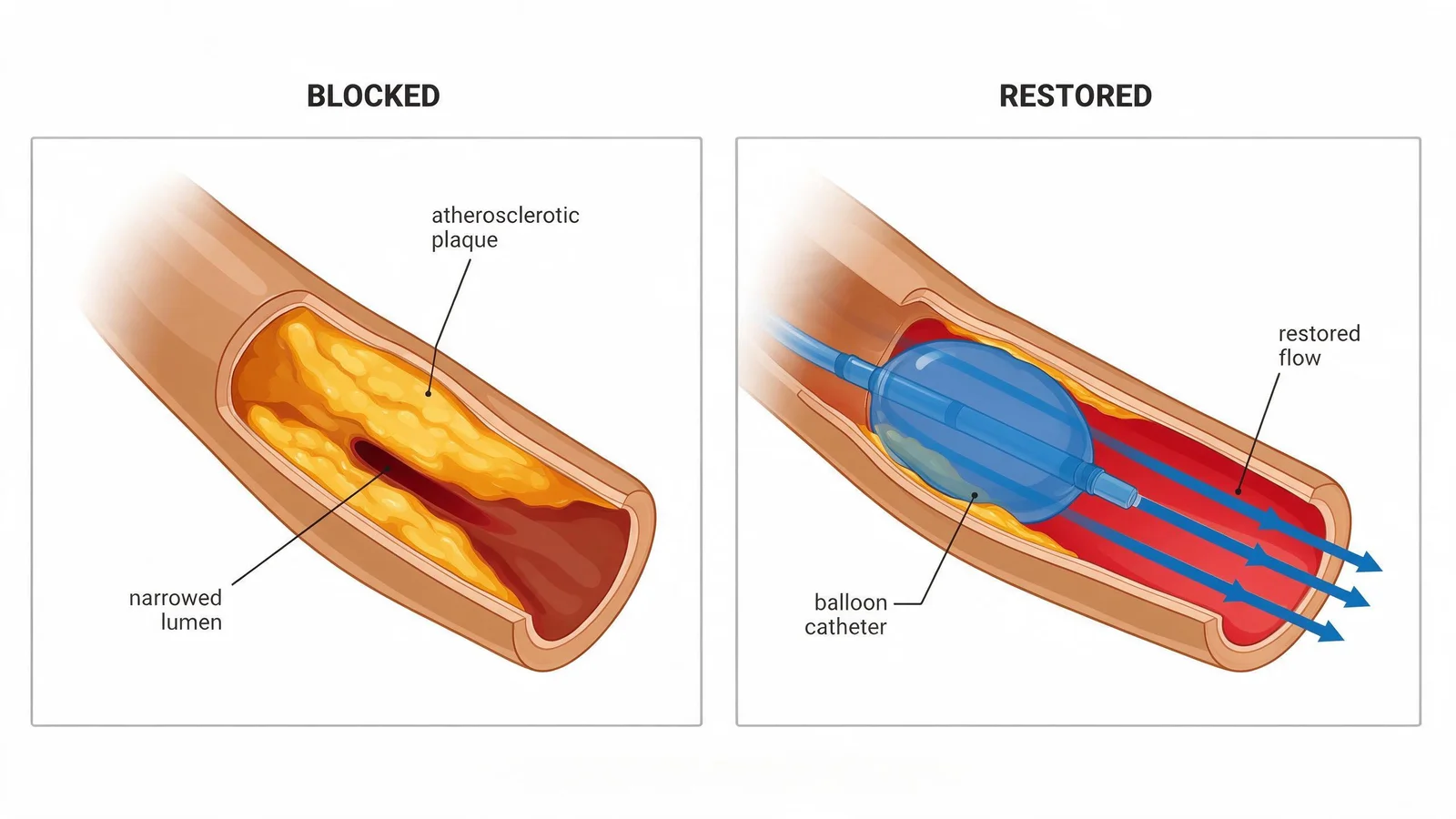
Revascularization restores arterial inflow to the ischemic foot. Our vascular team specializes in infra-popliteal and pedal-arch disease — the tibial, peroneal, and metatarsal vessels that carry blood to the toes. This is where most DFU-related ischemia originates, and where standard centers often stop.
What makes it different
Standard angioplasty targets the popliteal and tibial arteries above the ankle. Our team also accesses the plantar arch and metatarsal vessels using 0.014-inch coronary micro-guidewires and drug-coated micro-balloons. When the conventional antegrade approach (from groin to foot) is blocked, we use retrograde pedal access — entering through a foot vessel and working backwards — to restore flow where antegrade techniques cannot reach.
Procedure
- Pre-procedure CTA or duplex imaging maps every target vessel to the toes
- Micro-balloon catheters cross the lesion; prolonged inflation reshapes the vessel wall
- Drug-coated balloons (DCB) are used in tibial and pedal segments to reduce restenosis
- Retrograde plantar access is used when antegrade approach is not possible
- Post-procedure Doppler confirms improved foot perfusion
Recovery
Most procedures are done under local anaesthesia with sedation. Patients resume wound care within 24 hours. Antiplatelet therapy continues for 3–6 months. Follow-up Doppler at 4, 8, and 12 weeks confirms vessel patency.
Most vascular centers in the US and Europe stop at above-the-knee or popliteal targets. Our specialists routinely enter the plantar arch and metatarsal vessels — smaller caliber, technically demanding — using micro-balloon catheters designed for coronary work. Retrograde pedal access (entering from the foot rather than the groin) is available at few centers worldwide and is a routine option here.
References
- Mustapha JA et al. Retrograde pedal access for revascularization of infrainguinal arterial occlusive disease. Cardiovasc Intervent Radiol. 2018;41(9):1325-1332.
- Agarwal S et al. Infrapopliteal angioplasty in patients with critical limb ischemia. J Vasc Surg. 2021;73(4):1334-1342.
- Defined daily doses of parenteral antibiotics — Cochrane Database Syst Rev. 2015.
What does this cost?
All-in costs at China's specialist DFU centres — including inpatient stay, procedures, and coordination — are typically far lower than equivalent private care in the US, UK, or EU. Most patients self-pay; we also support insurance reimbursement documentation. We provide a transparent itemised estimate before you commit to anything, at no charge.
Request a free cost estimate →Free medical record review
Share your diabetic foot ulcer records for a free specialist review. Our care coordination team responds within 24–48 hours with an honest assessment.
This website provides medical-information science popularization only. It does NOT provide online diagnosis, prescriptions, or medical advice. Consult a licensed physician for any medical decision.