Cuidado Avanzado de Heridas y NPWTi-d
Desbridamiento seriado multimodal combinado con NPWT en modo instilación: penetra el biofilm, elimina la infección un 50% más rápido y crea un lecho de granulación saludable en días, no en semanas.
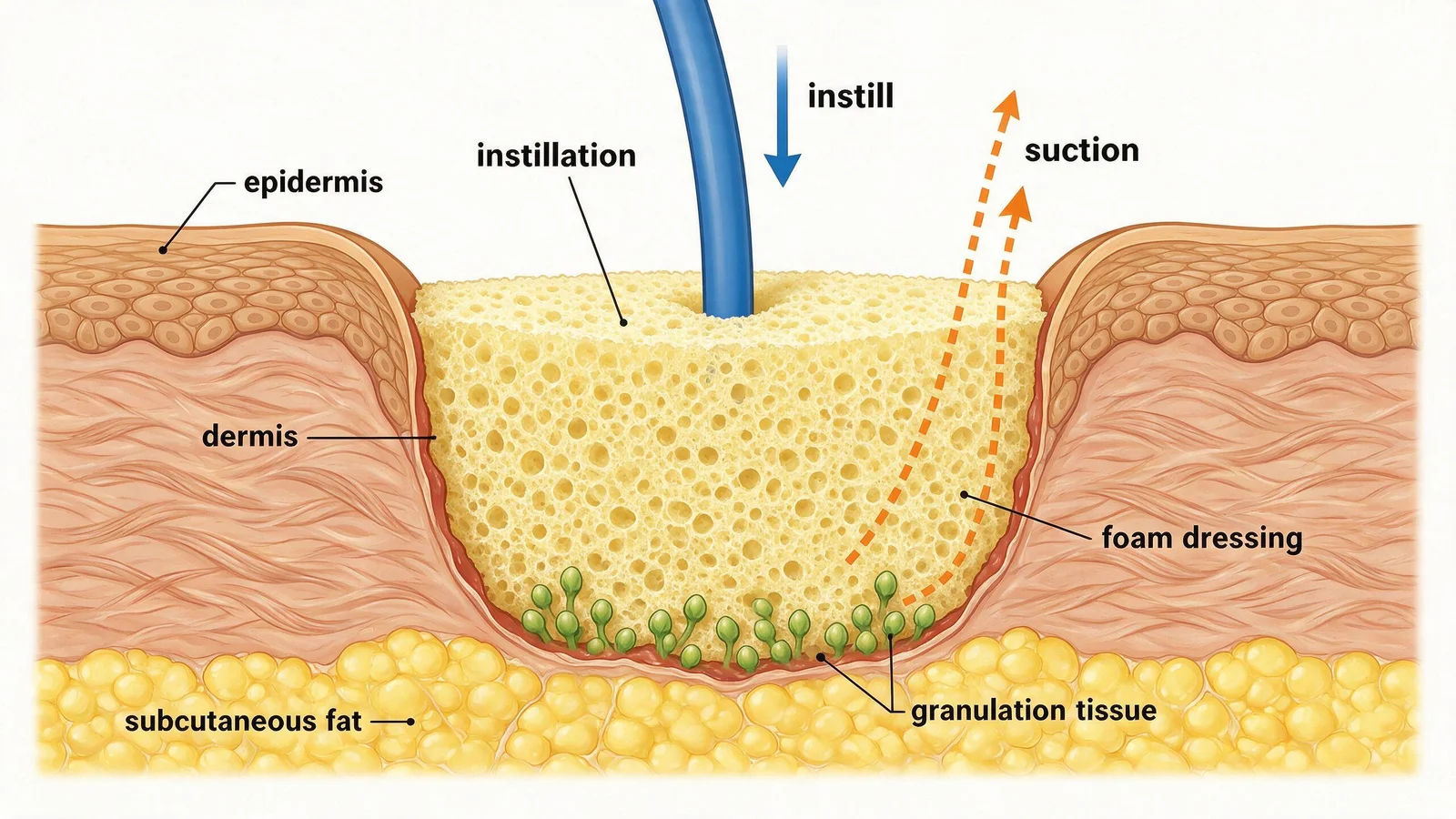
El cuidado avanzado de heridas en nuestros centros no es una técnica única: es un protocolo estructurado y escalonado que elimina las barreras para la curación una por una. La pieza central es la NPWTi-d (terapia de presión negativa con instilación y tiempo de permanencia), combinada con desbridamiento multimodal seriado y manejo sistémico coordinado.
Por qué el biofilm es el problema clave
La mayoría de las úlceras de pie diabético que no cicatrizan se mantienen abiertas por el biofilm bacteriano, una comunidad microbiana protegida que los antibióticos convencionales y los apósitos estándar no pueden penetrar. La NPWT estándar reduce el edema y promueve la granulación, pero no altera el biofilm. La NPWTi-d añade un ciclo de irrigación que administra solución antimicrobiana directamente en la herida, permaneciendo el tiempo suficiente para ablandar la matriz del biofilm antes de reanudar la succión.
El protocolo
- El hisopo microbiológico y la evaluación del biofilm determinan la solución de irrigación (salina, antiséptica o antifúngica)
- El desbridamiento cortante, a veces combinado con desbridamiento ultrasónico o hidrodesbridamiento, elimina el tejido no viable y altera la superficie del biofilm
- Se aplica el dispositivo NPWTi-d: instilación programada, tiempo de permanencia (10-20 min), luego succión; los apósitos se cambian cada 3-4 días
- Descarga de presión: yeso de contacto total o bota removible durante todo el curso de curación
- Cuidado paralelo: aporte de endocrinología para optimización glucémica, soporte nutricional, monitoreo vascular
Pasos siguientes después de NPWTi-d
Una vez establecido un lecho de granulación limpio, las heridas pueden progresar a cierre secundario, injerto de piel de espesor parcial o injerto de células epidérmicas, según el tamaño y la profundidad. La fase de NPWTi-d generalmente dura de 2 a 4 semanas.
La NPWT estándar, disponible a nivel mundial, aplica solo succión continua. La NPWTi-d añade un ciclo de irrigación programado: el dispositivo lava la cavidad de la herida con solución antimicrobiana o salina, permanece brevemente para ablandar la escara y penetrar el biofilm, y luego reanuda la succión. El equipo (V.A.C. VERAFLO) se vende en EE. UU., pero el protocolo sistemático que lo combina con desbridamiento multimodal, descarga de presión precisa y manejo glucémico se aplica de manera más consistente en nuestros centros especializados que en hospitales generales.
References
- Kim PJ et al. Negative pressure wound therapy with instillation: review of evidence and recommendations. Wounds. 2018;30(10):E90-E94.
- Liu Z et al. Negative pressure wound therapy for treating foot wounds in people with diabetes mellitus. Int Wound J. 2020;17(4):955-964.
- Armstrong DG, Lavery LA. Negative pressure wound therapy after partial diabetic foot amputation. Lancet. 2005;366(9498):1704-1710.
¿Cuánto cuesta?
Los costos integrales en los centros especializados en DFU de China, incluida la estadía hospitalaria, los procedimientos y la coordinación, suelen ser mucho más bajos que la atención privada equivalente en EE. UU., Reino Unido o la UE. La mayoría de los pacientes pagan por cuenta propia; también apoyamos la documentación para el reembolso del seguro. Proporcionamos un presupuesto detallado y transparente antes de que usted se comprometa a algo, sin cargo.
Solicite un presupuesto gratuito →Solicite una revisión de caso gratuita
Nuestro equipo de coordinación de atención revisará su caso y responderá dentro de 24 a 48 horas.
Este sitio web proporciona únicamente información médica de divulgación científica. NO ofrece diagnósticos en línea, recetas ni asesoramiento médico. Consulte a un médico autorizado para cualquier decisión médica.